
Upcoming Full Release and Update v1.8.0 Showcase
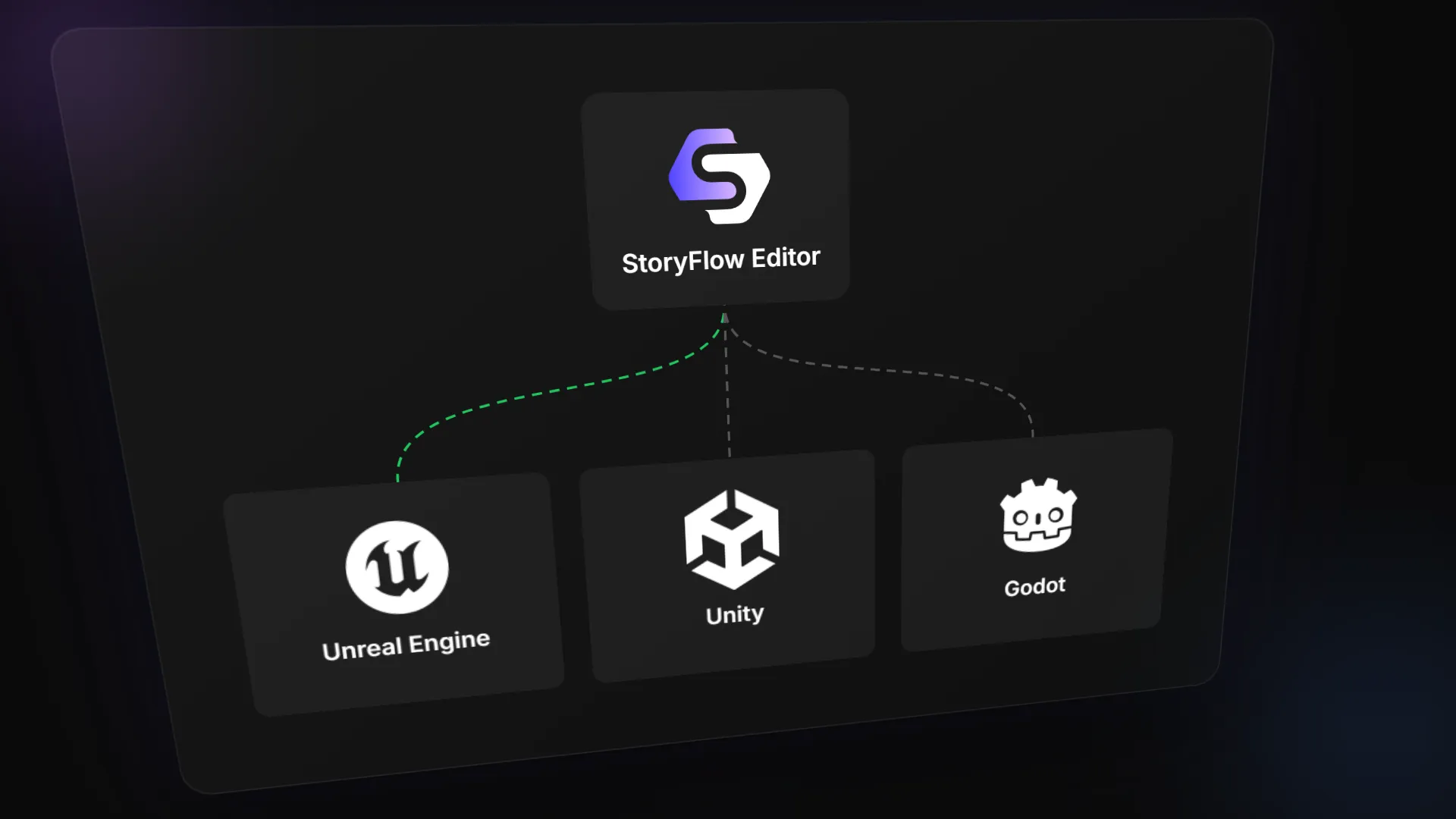
StoryFlow Editor went into Steam Early Access on November 6, 2025. Ten months and twenty three updates later it has grown into something fairly different from the tool that launched that day: engine plugins for Unreal, Unity and Godot, an interface editor with animations of its own, characters, save and load support and a long tail of smaller conveniences.
September brings the largest update of all of them. StoryFlow Editor v1.8.0 arrives next month with five major additions that change how a project is written, organised and shipped, and all three engine plugins update alongside it.
It also marks a turning point for the project itself, and that is where this post really starts.
The end of Early Access
StoryFlow Editor is approaching its exit from Steam Early Access, and it is close enough now to put a window on it: the full release arrives before the end of 2026, as v2.0.0. The exact date will be announced closer to the time.
Early Access was the right decision for a young tool. It put the editor in front of working projects while it was still forming, and the work has changed shape since. Less time goes into filling gaps and more into polish, edge cases and the quiet reliability a tool needs before anyone trusts years of writing to it. That shift is what maturing looks like from the inside, and v1.8.0 is its clearest sign so far.
Who uses it has shifted as well. StoryFlow Editor started out serving solo writers and hobby projects, and smaller indie studios now build on it as the writing and dialogue layer for games in production. A team leans on a tool differently than one person does, and this update carries the marks of that.
Pricing after the release
Leaving Early Access will also raise the price, exactly as promised when Early Access began. Everyone who bought during Early Access paid the lowest price StoryFlow Editor will ever have, and that is deliberate. Those buyers backed an unfinished tool while it was still early in development, ran their own work through it and kept saying what was missing until it was there. Their feedback helped shape the editor into what it is today. StoryFlow Editor would not exist without them. The lowest price it will ever have is theirs, and it is the smallest way of saying thank you.
None of it changes retroactively either. Updates remain free for existing owners, v1.8.0 and v2.0.0 included, and the higher price applies only to new purchases made from the release onward.
For anyone still deciding, the window to buy at the current price closes when v2.0.0 lands.
A game built with StoryFlow Editor
Alongside those projects, a game of my own has been in development for a while now. StoryFlow Editor handles its writing and dialogue, and the databases arriving in v1.8.0 hold its game data, which keeps its items, its stats and the numbers behind them in order as the project grows. A game engine handles the rest. It gets its own announcement later, when there is more of it to show.
Being on the other side of the tool has been clarifying. Rough edges that read as minor while you are imagining how other people work become impossible to ignore once you meet them yourself, mid scene, with the evening already spoken for. That is where searching inside a script came from. Same with keeping design notes beside the story and describing items in a table rather than scattering them across nodes. A tool you use every day is very hard to lie to yourself about.
What is coming in v1.8.0
Five headline features, each of which would have made a reasonable update on its own.
Search inside script files
Ctrl+F now searches the contents of a script directly. Matches highlight on the canvas and can be stepped through one at a time, so finding a half remembered line in a graph of four hundred nodes takes seconds rather than a slow scroll. The same search works in the other editors, including data tables and notes, and project wide search remains for the times when the right file is not obvious.
A much better markdown editor
Notes have been part of StoryFlow Editor for a while, and they were adequate for a paragraph of reminders. In v1.8.0 the markdown editor becomes a genuine writing surface: a WYSIWYG mode with a document outline, find and replace, focus mode for long sessions, syntax highlighting inside code blocks, inline images that can be dropped straight onto the page and links between notes. A source mode is available for those who prefer raw markdown, and it stays in sync with the rich view.
Design bibles, character backgrounds and rough scene drafts can now live in the same project as the scripts they describe.
Canvas documents for prototyping
A canvas document is a freeform board of cards, arrows, colours and groups — a mind map rather than a flowchart. It serves the stage before the writing, when the shape of the second act is still unsettled and a node graph would force decisions that have not been made yet.
Cards hold formatted text rather than a bare label, so a rough scene can begin on the canvas and grow into something worth turning into a script. Arrows carry their own styling, which sounds cosmetic until a board holds three kinds of relationship that need telling apart at a glance.
Databases
Databases are likely to change how larger projects are structured. A database in StoryFlow Editor is a typed table of data: items, stats, quest definitions, tuning values, anything a game looks up rather than narrates. Fields are declared once and filled in through a spreadsheet style grid.
Two things make them more than a spreadsheet. First, they inherit. One table can be based on another, so a base Item defines price, weight and description, and every sword, potion and key inherits those fields while overriding only what differs. Second, scripts can read and write them at runtime, so a story can check a price, spend a resource or set a flag the rest of the game reads.
The part that matters for engine users: databases travel into the game with everything else. Exporting a project carries the tables along in a form Unreal, Unity and Godot read natively, and the plugins expose them to Blueprint, C# and GDScript. Combat code and dialogue end up reading the same numbers from the same source, which removes the kind of duplication that breaks games late in development.
Localization dashboard
Every translatable string in the project lands in a single view, one column per language. Dialogue, options, interface text, character names and database values are collected automatically, so nothing depends on remembering to mark a line for translation.
Translation happens in place, or through a CSV export that can be handed to a translator and imported back. Editing a line that has already been translated flags its translations as outdated rather than letting them drift silently, with the old source shown beside the new one. Quality checks catch the usual traps, such as a variable placeholder that survives in one language and vanishes in another, and a progress readout per language shows what is genuinely finished.
Translations leave the editor with everything else, into the HTML export and into all three engines, with an API for switching language at runtime. Script nodes are available as well, so an in game settings menu can offer a language list the project builds itself.
Availability
v1.8.0 ships in September as a free update for everyone who owns StoryFlow Editor, on Steam and on itch.io. The engine plugins update alongside it, so Unreal, Unity and Godot projects gain databases and localization at the same time as the editor.
It is not the last stop before the release. A few smaller updates follow it, v1.9.0 among them, and v2.0.0 is the one that closes out Early Access, with the release date announcement and the price change arriving alongside it.
None of that is a finishing line, though. The core is already in place and solid enough for the projects being built on it today, which is what a 2.0 ought to mean. Development carries on well past it, with a few large plans already waiting, and the difference is that they will land as additions to a finished tool rather than as the missing pieces of an unfinished one.
Enjoyed this post?
Subscribe to get notified about new articles and updates.
Thank you to everyone still reporting bugs, requesting features and saying plainly when something feels wrong. It is the reason the next one gets better.
Related Posts


Enjoyed this post?
Subscribe to get notified about new articles and updates.