
How to Write Branching Dialogue That Doesn't Suck
You write a brilliant line of dialogue. The kind of line you'd put in a writing portfolio. You drop it into a branching dialogue scene and watch the playtester walk right past it without reacting.
Something is broken, and it isn't the line.
Branching dialogue eats good writing alive. Lines that would land in a novel die in a choice menu. Scenes that would carry a film fall apart the moment the player chooses what happens next. Writers who can make me cry over a novella turn out flat, lifeless work the first time they try to write a branching scene. This isn't because they got worse, but because branching is a different craft that almost nobody teaches.
I've been writing and editing branching dialogue for years now. I've made every mistake on this list, usually twice. What follows are five craft principles I've learned the hard way, the kind of stuff senior narrative designers know in their bones but rarely write down. Pair them with the architecture patterns from The Branching Dialogue Nightmare and you have the engineering and the writing sides covered.
If you want your branching scenes to feel like the ones in Disco Elysium, Pentiment or Citizen Sleeper, this is where it starts. Not with better prose. With a different way of writing.
The whole post in five lines, if you only have thirty seconds:
- Choice copy is microcraft. The button labels an act, not a preview of the line.
- Choices express character, not plot. A choice should ask who the player is, not what happens next.
- Convergence is your friend. Every divergence needs a known reconvergence point.
- Plant now, water later. The payoff for a choice should arrive three scenes later, not in the next line.
- Voice consistency is the silent killer. The same character has to hold across every branch the player might take.
The long version starts below.
What's Actually Different About Branching
Linear writing has one job: get a single reader through a single sequence of events. Every line of dialogue serves that one path. The cuts you'd make to a novel chapter are the cuts you'd make to a film script. Anything that doesn't push the through-line forward gets cut.
Branching dialogue has dozens of through-lines, sometimes hundreds. The same NPC has to feel right whether the player charmed her, threatened her, lied to her or skipped half her dialogue tree. Each path needs the same character integrity, the same tonal control, the same emotional shape, even though no single player will see them all.
The writer's job changes. You stop composing the scene and start composing the space of possible scenes. You're not writing a path through the woods. You're designing the woods, and you have to make sure every path through them feels like the same forest.
This is the part that breaks people coming from screenwriting. In a film, every scene is the scene. In branching dialogue, the scene is whatever the player makes of it. The character on screen has to handle a polite player, a hostile player, a player who tries to be funny, a player who picks every option in the wrong order. They all need to walk away with the same impression of who that character is.
The five principles below are about making that work without writing fifty drafts of every scene.
Principle 1: Choice Copy Is Microcraft
The smallest unit in a branching scene is the button text, and most writers treat it as a label when it should be a piece of writing in its own right.
What makes a good choice in branching dialogue?
The first thing you should obsess over is the button text. The words on the choice. Not the line your character will speak when the choice is picked, the choice itself.
Most writers paraphrase. The line is:
"I never wanted any of this. I just wanted to be left alone, and now they're all dead because of me."
And the choice button reads:
"I never wanted any of this. I just wanted to be left alone..."
That's not a choice. That's a preview. The player is reading a truncated version of the line they're about to hear. There's no decision involved, no character expression. They tap it and watch the same line play in full.
Compare that to Disco Elysium's choices. The line you're about to speak might be a four-sentence paragraph of police-procedural deflection. The button reads:
"Lie."
One word. The button is not paraphrasing the line. It's labeling the act. The player isn't picking a line, they're picking what their character does. The line itself is a consequence of that choice, and the player gets to be surprised by their own character.
Pentiment does the same thing more subtly. Choices read like stage directions: "[Disagree gently]", "[Argue from theology]", "[Hold your tongue]". Citizen Sleeper does it with personality-coded options: "[Earnest]", "[Cynical]", "[Curious]". The button text reveals who the player is choosing to be in this moment, not what they're choosing to say.
The rule: the choice button is its own medium. It exists to let the player perform an act, not to preview a line. If your buttons could be replaced with "[Continue 1]" and "[Continue 2]" without losing meaning, you are wasting the most important interactive moment in the scene.
A test for any choice in your script: cover the line that follows it. Does the button text still mean something? If not, rewrite the button until it does.
Principle 2: Choices Express Character, Not Plot
This is the principle that punishes screenwriting habits the hardest, because it asks you to stop using choices to advance plot.
Why do branching choices feel meaningless?
The second principle is harder to internalize because it requires giving up something most writers love: plot control.
A weak choice asks the player what happens next. A strong choice asks the player who they are.
"Go left" or "Go right" is what happens next. "Turn back to help the wounded soldier" or "Press on while you still can" is who you are. The first is a vending machine. The second is closer to a mirror.
Mass Effect's signature choice system, for all its flaws, understood this. Paragon and Renegade weren't outcome buttons, they were identity buttons. You weren't picking what Shepard did. You were picking what kind of Shepard you were becoming. The outcome was secondary; the performance was the point.
Disco Elysium pushes this even further by attaching choices to internal skills. You don't choose to be empathetic, you choose to listen to your Empathy skill. The choice isn't an external action, it's an act of self-definition. Which voice in your own head do you let speak?
Most weak choices fail by treating the player as a route-picker. The dialogue tree branches because branching is what dialogue trees do. The player isn't being asked anything meaningful. They're being asked to keep the conversation moving.
A useful gut check: imagine the player picking your choice with their finger an inch from the button. What are they performing in that moment? If the answer is "advancing the conversation", rewrite. The answer should be "being a particular kind of person".
This is also why so many "good or evil" systems fail. The choice is between two abstract moral positions instead of two specific human reactions. "Spare him" or "Kill him" is a worse choice than "He's begging for his life. Pull the trigger." or "He's begging for his life. Lower your weapon." One is a moral abstract. The other is a person standing in front of another person, deciding.
Write choices that ask the player to be someone, not to do something. Plot is the byproduct of writing identity-driven choices, not the goal.
Principle 3: Convergence Is Your Friend
Every shipped narrative game converges far more than its players realize, and the writer's job is making that convergence invisible.
How much should branching dialogue actually branch?
Less than you think. Almost certainly less than you think.
The fantasy of branching writing is that every choice produces a meaningfully different story. The reality is that no studio with shipped narrative games actually does that. Disco Elysium doesn't. Pentiment doesn't. Even Baldur's Gate 3, with its absurd writing budget, converges constantly. The trick is convergence that feels invisible.
A useful concept here is what narrative designer Sam Kabo Ashwell calls Branch and Bottleneck structure, also known in the choose-your-own-adventure tradition as foldback. The idea is the same: a story that allows divergent choices but always folds them back into a smaller set of canonical beats. Three branches go out, two converge, then split again, then converge again. The player feels freedom inside each branch. The writer only has to write a manageable number of beats.
The mistake first-time branching writers make is fully diverging stories. You write Option A, where the king dies, and Option B, where the king lives. Now every scene in your game has two versions. You've doubled your writing workload, and the choice you actually wanted to feel important is competing with fifty other branched scenes you never wanted to write.
The fix is to converge as soon as you can without breaking the player's sense of consequence. Maybe the king dies in both branches, but the player who pushed for clemency carries different baggage forward. The plot reconverges. The character experience does not.
Mid-scene reconvergence is even more powerful. The scene branches at choice one, then folds back at choice three, branches again at choice five, folds back at the end. The player walks out feeling like they shaped the scene. The writer wrote a single scene with three branch points instead of eight separate scenes.
A useful rule: every divergence should have a known reconvergence. Before you write a branch, decide where it merges back. If you can't, you're not writing branching dialogue, you're writing two games.
Principle 4: Plant Now, Water Later
The principle is borrowed from dramatic writing: setup early, payoff late, and trust the reader to forget the setup until the payoff lands.
How do you make player choices feel like they matter?
By making the consequence arrive late.
The mechanical version of consequence is the immediate version. The player picks Option A, the next line acknowledges Option A, the player moves on. The choice felt acknowledged. It did not feel meaningful.
Meaningful consequence is delayed consequence. The player insulted the merchant in chapter one. Five chapters later, the merchant's nephew is the gatekeeper to the city's archives, and he remembers what was said. The player doesn't connect the dots until the gatekeeper sneers at them. Then the dots connect all at once, and the original choice retroactively becomes important.
This is the difference between dialogue that responds to choices and dialogue that remembers them. Response is short-term. Memory is what players tell their friends about a week later. Most writers stop at response and never get to memory.
Disco Elysium is the gold standard for delayed consequence. A drunk comment in the first hour of the game becomes a major character beat eight hours later. The player doesn't even remember saying it. The character does. The player's reaction is the experience the writer was actually building toward.
The practical version of this principle: every meaningful choice should plant a variable, and that variable should fire at least one scene away, ideally several. The architecture of how to track this is covered in how to use variables. The craft of it is restraint. Don't fire the consequence in the next line. Don't fire it on the next page. Let the player forget. Then surprise them with the moment that proves they were heard.
A useful planning trick: when you write a choice, immediately note the scene where it pays off. If you can't name one, you're writing the illusion of choice, not the substance of it. Either find the payoff or cut the choice.
Principle 5: Voice Consistency Is the Silent Killer
This is the principle players notice without being able to articulate, because no individual scene exposes the failure, only the cumulative impression does.
How do you keep character voice consistent across branches?
By treating voice as the most fragile thing in the script.
The failure mode goes like this. You write Hubert the merchant on Monday in a charming, world-weary voice. On Friday, you write his "angry at the player" branch in a clipped, sarcastic voice. Six weeks later, you write his "befriended" branch in a warm, paternal voice. None of those branches feel like the same person. They feel like three writers having a meeting about what Hubert might say.
Branching multiplies this problem by the number of branches. A linear character gets one voice and you maintain it across a single read-through. A branching character gets one voice and has to maintain it across forty disconnected read-throughs.
The technical fix is the easy part. Keep a character voice document for every important character. Two paragraphs of what they sound like, three or four signature speech patterns, two or three words they would never use. Refer to it every time you write a branch for that character. It feels like overhead until you don't do it, and then you spend a week rewriting forty scenes to make them sound like one person.
The craft fix is harder. Read the whole branch end to end before you ship it. Not the scene you just wrote. The whole branch from the player's first encounter with this character to their last. Read it as a player who picked these choices. The voice should hold. If it doesn't, you can hear the seams.
Reading lines aloud is the cheapest tell. If your "warm Hubert" can't be read out loud in the same voice as your "angry Hubert" without changing pitch beyond what an actor could reasonably do in one performance, you have a voice problem. Solo writers can do this in their own living room. Teams can do it in a quick read-through over a call. The point isn't formality, it's hearing the character in continuous time instead of in fragments.
Voice is the silent killer of branching writing because no individual scene exposes it. Only the aggregate does. Most writers don't notice it. Most players do.
A Scene Rewritten With the Five Principles
Here is a scene I'm going to write badly first, then fix. The setup: the player has been investigating a series of murders. They've cornered the killer, Mira, in an old church at night. Mira is unarmed. She's also a character the player has met three or four times before, sometimes as an ally.
The bad version
Mira: "I never wanted it to come to this. You don't understand."
Choices:
- "I want to understand. Tell me why."
- "There's nothing to understand. You killed them."
- "Let's just end this."
Whichever the player picks, Mira monologues for two paragraphs about her motive. The scene ends with the player choosing to arrest her or let her go.
Look at what's broken.
The choices paraphrase the lines the player will speak. They preview rather than perform. None of them ask the player who they are. The first two are bland identity options (curious vs. judgmental), the third is a stage direction. The scene branches at the choice but immediately converges into the same monologue, so the choice was cosmetic. The arrest-or-release decision is mechanical: there's no track record of choices that pushed the player into one camp. Nothing was planted three chapters ago to pay off here.
The scene is functional but lifeless.
The fixed version
Mira: "I never wanted it to come to this. You don't understand."
Choices:
- [She's pleading. Believe her.]
- [She's pleading. Use it.]
- [Don't speak.]
Now look at what the choices do.
None of them paraphrase a line. Each one is an act. The player isn't picking what to say, they're picking what to be in this moment. Are you a person who lets yourself be moved? A person who weaponizes weakness? A person who refuses the trap of conversation entirely? The line that follows is a consequence of that choice, and the choice itself is the character work.
The third choice (silence) is doing something the bad version couldn't: it acknowledges that not speaking is also a performance. Players who pick it are not absent. They are deliberate.
Now layer in delayed consequence. The player who befriended Mira in chapter two sees these choices differently than the player who never met her. The "She's pleading. Use it." option costs more if you ate dinner with her in chapter two. The button text doesn't change. The weight does. That weight was planted hours ago and is finally being collected.
Finally, convergence. Whatever the player picks, Mira eventually confesses her motive. The plot beat is the same. What changes is the player's relationship to that confession, and the lingering memory of how they got it. That lingering memory is what will color the next three chapters of the game.
Notice how little of the fix is at the line level. The lines barely moved. The choices and their positioning did all the work. That is the craft. You can write the same lines and produce a dead scene or a living one depending on how you stage the choices around them.
Common Mistakes in Branching Dialogue
If the five principles above are the map, these are the potholes you keep driving into.
What are the most common branching dialogue mistakes?
Five mistakes you'll see in almost every first-time branching script, in roughly the order they show up.
The vending-machine choice. Choices that ask what happens next, not who the player is. "Go upstairs / Go downstairs." If the choice could be replaced by a coin flip without losing meaning, it isn't doing character work.
The previewed choice. Buttons that paraphrase the line they'll trigger. The player is reading a smaller version of what they're about to hear. There is no decision happening, only navigation. Replace the paraphrase with the act.
The instant consequence. Choices whose impact is fully resolved in the next line. The scene acknowledges the choice and moves on. The player remembers being acknowledged for ten seconds, then forgets. Plant in scene one, water in scene four.
The Paragon/Renegade trap. Binary morality scales that ask the player to be Good or Bad over and over. Real choices are not aligned on a single moral axis. A character can be cruel because they care, kind because they're afraid, generous because they're guilty. Binary morality flattens all of this into "did you click the blue button or the red one." Players notice. They stop choosing characters and start clicking colors.
The fake dichotomy. Choices framed as opposites that mean the same thing in context. "Tell her the truth" or "Lie to her" sounds binary until the truth and the lie produce the same scene. If the next ten lines are identical regardless of choice, the choice is performance theater and players can feel it.
A bonus mistake worth its own paragraph: the lose-lose without weight. A choice between two awful options can be powerful if the player is implicated in both ("you push the rebel off the boat" or "you let the soldier on the boat shoot her"). It is hollow if neither option is anchored to anything the player has built toward. Tragedy without setup is just unpleasantness. The setup is the craft.
Almost every dead scene I've debugged has at least two of these mistakes layered on top of each other. Fixing one usually surfaces the others.
Tools That Help With Branching Dialogue Writing
The honest answer: any tool that lets you see the shape of the branching, and any tool that tracks variables you can refer to later.
Text-based formats like Ink and Yarn Spinner work well if you're comfortable reading branching as code. They give you precise control and good version-control workflows. If your team is small and code-fluent, that's often enough.
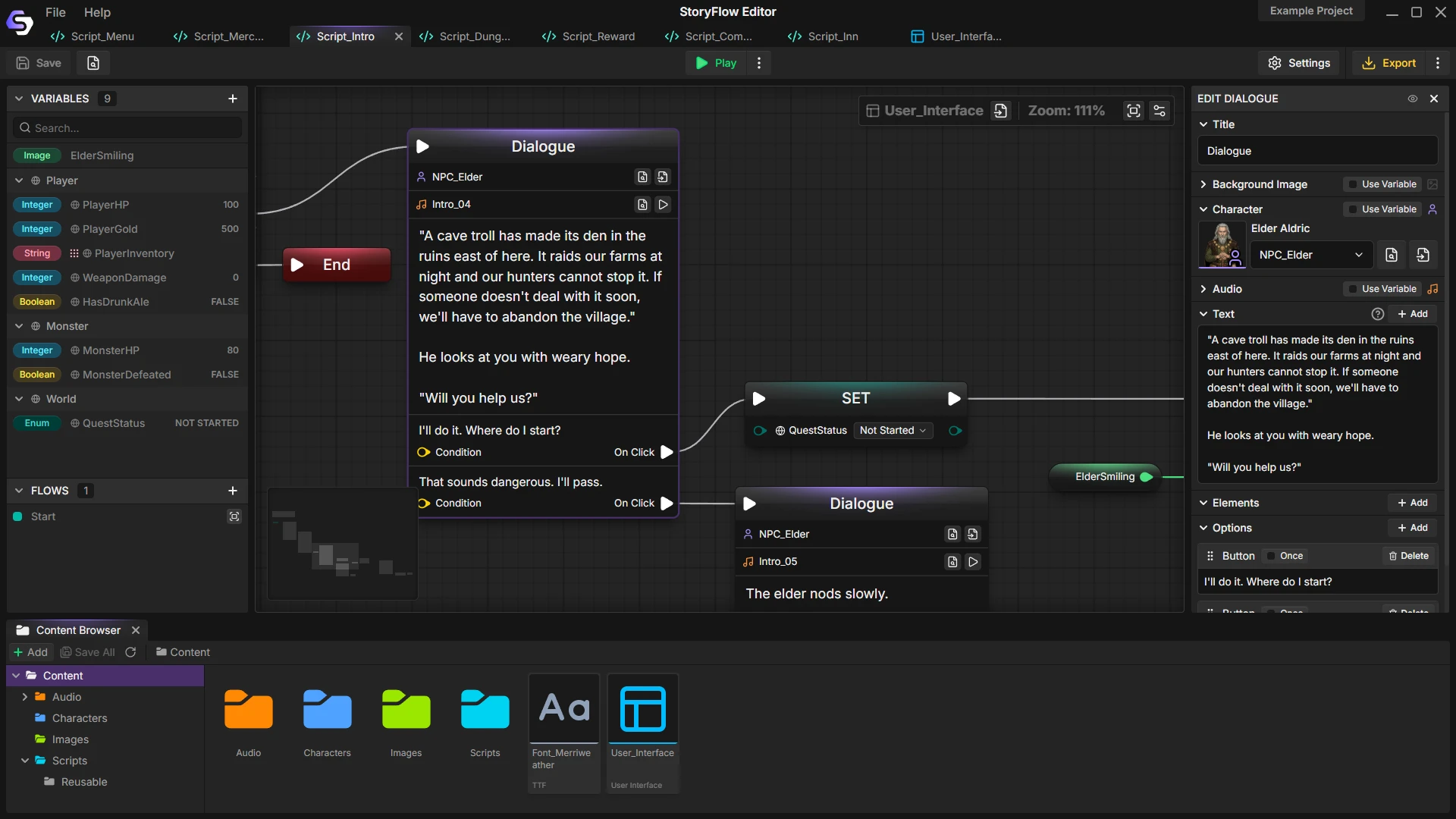
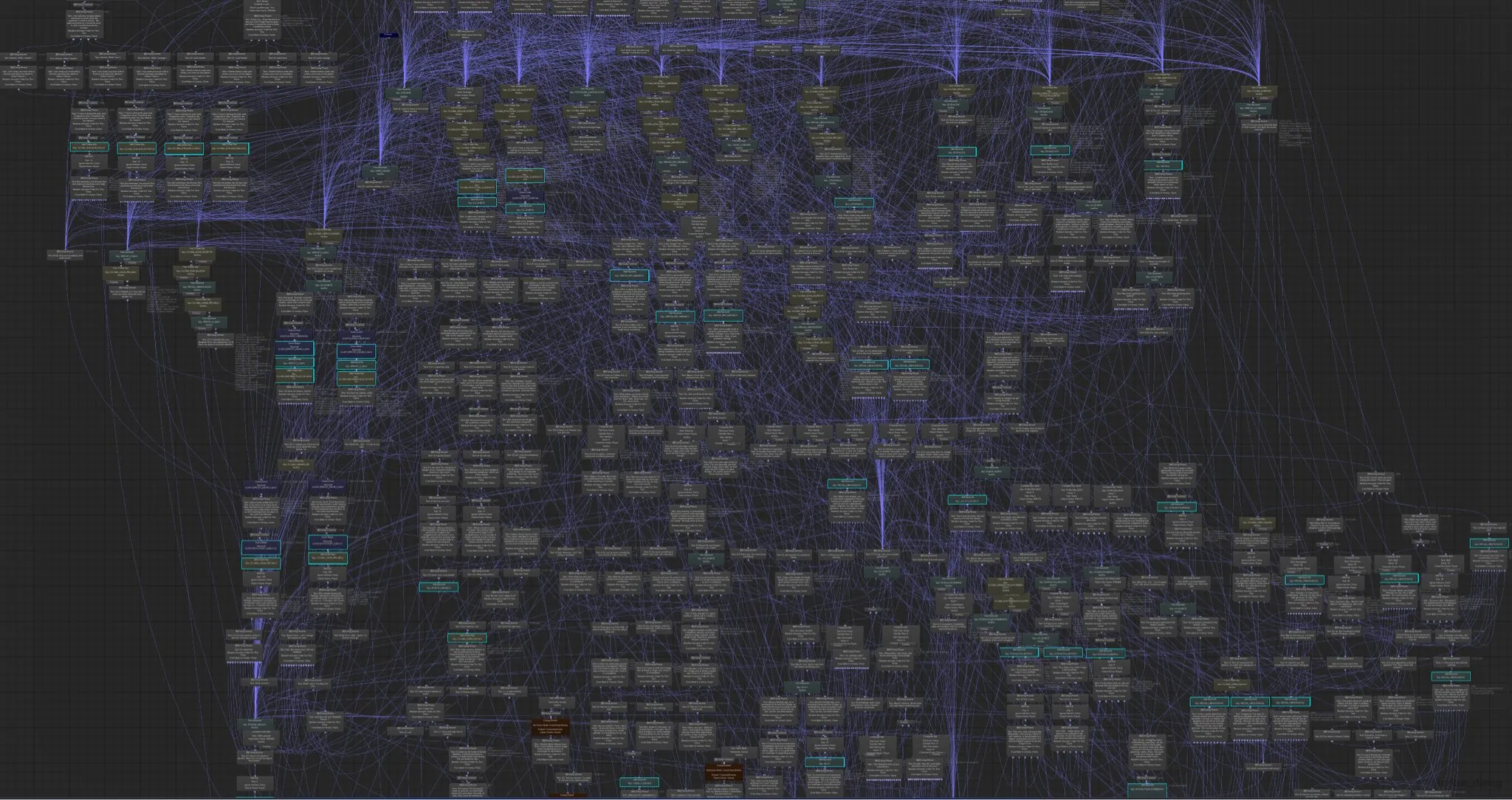
Visual node editors give you the second thing that matters: the ability to see the shape of your story. When you can look at the canvas and tell which scenes converge, where the foldback happens, which branches are dead ends, you write tighter. Convergence becomes a visual decision instead of a guess. A dedicated branching narrative tool gives you that view by default. StoryFlow Editor was built around this idea, and the variables system is specifically designed to make the "plant now, water later" pattern trackable across long stretches of script. If you're comparing tools more broadly, the 6 best narrative design tools post has a fuller breakdown, and if you're approaching this from the visual novel side, the visual novel without code guide covers the broader production pipeline.
The bigger point is that the principles above work in any tool. Whatever you use, build the habit of looking at the whole shape of the scene before you write the next line. Most branching dialogue dies because the writer was looking at one line at a time. The craft lives in the spaces between the lines.
Frequently Asked Questions
How is writing branching dialogue different from writing linear dialogue?
Linear dialogue has one through-line. Branching dialogue has dozens. The writer stops composing a single scene and starts composing the space of possible scenes. The same character has to feel right across every branch the player might take, even though no single player sees them all. The craft shifts from prose composition to character integrity under combinatorial pressure.
What makes a good choice in branching dialogue?
A good choice asks the player who they are, not what happens next. The button text should label an act of identity (lie, push back, listen) rather than paraphrase the line that will follow. The cleanest test: cover the line that comes after the choice and check if the button still means something. If it doesn't, the choice is doing nothing.
How do you stop branching dialogue from becoming unmanageable?
Converge constantly. Every divergence should have a known reconvergence point. Foldback structure, where branches fan out and rejoin a smaller set of canonical beats, is how every shipped narrative game from Disco Elysium to Baldur's Gate 3 handles complexity. If you can't name where a branch merges back, you're writing two games instead of one branching scene.
How do you make player choices feel like they matter without writing infinite branches?
Delay the consequence. Choices that pay off in the next line feel mechanical. Choices that pay off three scenes later feel like the world remembered them. Plant a variable now, fire it later, and let the player forget they planted it. The surprise of being remembered is the experience players talk about. Immediate acknowledgment is the experience they forget.
What's the most common writing mistake in branching dialogue?
The vending-machine choice: options that ask the player to pick what happens next rather than perform an identity. If your choice could be replaced with "Continue 1" and "Continue 2" without losing meaning, it isn't doing character work. Strong choices act as mirrors that show the player who they are. Weak ones are just doors that move the plot forward.
Branching dialogue is one of the hardest forms of writing in games because it punishes the instincts that make linear writing good. Tight scenes, fixed character beats, controlled reveals: all of these get harder once the player can rearrange the order. The five principles above are how I keep my scenes alive when the player goes off-script. Look at the shape of the scene before you write the line.
If you want a visual editor built around exactly this kind of writing, StoryFlow Editor is on Steam.
Related Posts
Enjoyed this post?
Subscribe to get notified about new articles and updates.