Looking for an Articy:draft Alternative?
StoryFlow Editor is a node-based visual editor for branching dialogue and interactive narratives. One-time $30. Free open-source plugins for Unity, Unreal Engine and Godot. No subscription, no per-seat fees, no object-count cap.
Why developers look for an articy:draft alternative
Articy:draft X is a great tool. It powers some of the biggest narrative games shipped this decade. But the same features that make it work for AAA studios are overkill for most indie game developers and writers. The reasons people search for an articy:draft alternative tend to be the same three.
The subscription adds up. Articy:draft X offers monthly and annual subscriptions. A solo developer prototyping a visual novel may prefer a one-time purchase instead of a recurring bill. Check articy's current pricing when comparing costs.
The free tier has a limit. The free articy tier caps each project at 700 objects. It can be useful for a prototype, while a larger project may need a subscription.
You want a focused workflow. Articy has dedicated tools for a large game's content pipeline. StoryFlow Editor keeps dialogue, characters, translations and reusable Data Assets together without requiring you to set up that broader pipeline.
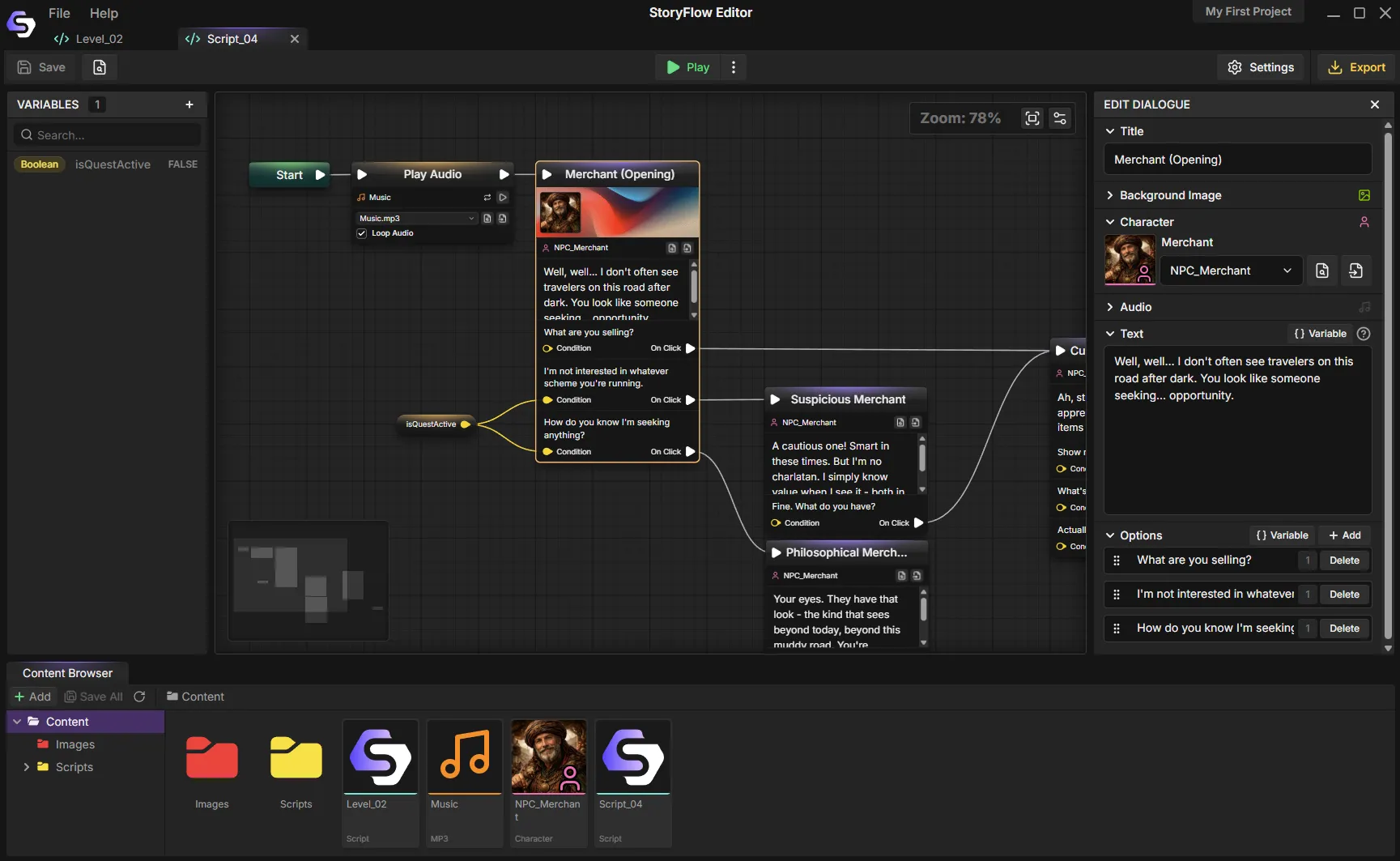
StoryFlow Editor canvas. Node-based, Blueprint-style, no code.
StoryFlow Editor vs articy:draft at a glance
Quick comparison of the workflow features that matter most to indie game developers and narrative designers.
| Feature | StoryFlow Editor | articy:draft X |
|---|---|---|
| Pricing model | $30 one-time, lifetime updates | Monthly or annual subscription |
| Free tier | Steam demo | Limited to 700 objects per project |
| Visual editor style | Node-based, Blueprint-feel | Flow editor + database UI |
| Unity plugin | Free, open-source (MIT) | Free importer |
| Unreal Engine plugin | Free, open-source (MIT) | Free importer |
| Godot plugin | Free, open-source (MIT) | Generic JSON export only |
| HTML export | One-click playable build | Not built in |
| Live sync to engine | WebSocket sync to Unity, Unreal and Godot | Plugin re-import workflow |
| File format | Editable project files and JSON export | Proprietary project files with export options |
| Multi-user editing | Git-based project workflow | Built-in multi-user with version control |
| Reusable game content | Data Assets with inheritance and a Table Viewer | Game object database and templates |
| Localization | Built-in translation editor and CSV exchange | Localization and voice-over tools, optional DeepL |
| AAA track record | Indie focus | Disco Elysium, Hogwarts Legacy, Suzerain |
| Platforms (editor) | Windows, macOS, Linux | Windows, macOS |
For current articy:draft X plans and features, see articy's pricing and feature list.
Where articy:draft still wins
Articy:draft X has strengths that matter when a large team manages an entire game's content pipeline.
- Broader content tools. Articy has dedicated game object and location workflows plus customizable templates. StoryFlow Editor Data Assets can hold reusable content such as items and locations, but articy offers more specialized tools for managing it.
- Built-in multi-user collaboration. Articy has its own version control with multi-user editing. StoryFlow relies on Git, which works well for solo developers and small teams but is less convenient for 20-person writer rooms.
- Localization tooling. StoryFlow Editor has a translation editor, CSV import and export and language switching. Articy adds voice-over localization management and optional DeepL translation.
- AAA shipping track record. Articy has years of shipped commercial titles behind it including Disco Elysium, Hogwarts Legacy, The Talos Principle 2 and Suzerain. StoryFlow Editor is the newer tool and still building that reputation.
If those broader tools matter to your team, articy:draft X may be the better fit. StoryFlow Editor covers dialogue authoring, shared game data and localization with a one-time purchase.
How to switch from articy:draft to StoryFlow Editor
There is no automated importer yet. For a small project, use this five-step path and allow time to rebuild the flow manually.
- Export your articy:draft project to JSON. Articy's JSON export gives you flow, character and variable data you can use as a reference.
- Open StoryFlow Editor and create a fresh project. The canvas opens with a single Start node. Every dialogue, choice and branch hangs off that point.
- Recreate your characters, variables and Data Assets first. Use your articy content as a reference for names, portraits and default values.
- Rebuild your flow node by node. Drop dialogue, choice and branch nodes onto the canvas and wire them up. Most teams move faster than expected here because the structure already exists in the articy file.
- Hook the runtime into your engine. Install the free Unity, Unreal Engine or Godot plugin and import your project export. Branching narrative plays in the engine without writing flow-control code.
For a complete walkthrough of the node-based workflow, the visual novel build guide covers the same workflow from scratch.
Frequently Asked Questions
Is StoryFlow Editor a real articy:draft alternative?
Yes. StoryFlow Editor combines visual dialogue and branching with Data Assets for reusable game content, built-in localization and exports to HTML, JSON and free plugins for Unity, Unreal Engine and Godot. Articy:draft X has a broader content pipeline and built-in multi-user collaboration, so the best fit depends on the scale of your project.
How is StoryFlow Editor different from articy:draft?
StoryFlow Editor uses a visual node graph for dialogue and logic and costs $30 as a one-time purchase. It exports playable HTML builds and provides free open-source runtime plugins for Unity, Unreal Engine and Godot. Articy:draft X offers a broader content pipeline with subscription plans and a limited free tier. Its Unity and Unreal importers are also free.
Can I migrate my articy:draft project to StoryFlow Editor?
There is no automated importer yet. Most teams migrate by re-creating their flow in StoryFlow Editor using the existing articy:draft project as a reference. Visual node editors make this faster than it sounds because the structure is already designed. Dialogue text and variable names usually copy over directly.
What does articy:draft do that StoryFlow Editor does not?
StoryFlow Editor now has Data Assets for items, locations and other reusable content, plus an in-editor localization workflow. Articy:draft X goes further with dedicated game object and location tools, built-in multi-user editing, voice-over localization tools and optional DeepL translation. It also has a longer track record on large shipped games.
Does StoryFlow Editor work with Unity, Unreal Engine and Godot like articy:draft does?
Yes. Free open-source runtime plugins are available for all three engines. The Unity package ships via UPM, the Unreal Engine plugin works with UE 5.3 to 5.8 and the Godot plugin is a GDScript add-on. Each plugin imports a StoryFlow Editor project export with scripts, characters, Data Assets and translations, then plays the supported story nodes natively.
How much does StoryFlow Editor cost compared to articy:draft?
StoryFlow Editor is a one-time $30 purchase on Steam or itch.io. articy:draft X offers monthly and annual subscriptions, plus a free tier limited to 700 objects per project. See articy's pricing page for current subscription prices.
Try the articy:draft alternative
StoryFlow Editor is a one-time $30 purchase on Steam and itch.io. The Steam demo is free if you want to try the workflow before buying.
Join the Community
Connect with StoryFlow Editor users, share your projects, leave feedback, vote for new features, report bugs and get support in our Discord community.
Join Discord